
Why I should read more Flaubert
And why many literary roads lead to him

Recently I was talking about how a lot of us go through that ‘I only read the classics’ pretentious phase – in fact some never leave it, but for me in was in my twenties and I fancied myself a bit of intellectual lady of letters, or at least I did between getting drunk and office jobs. If someone asked me what my favourite book was, I’d nonchalantly wave my cigarette in the air over my pinot grigio and respond ‘Crime and Punishment’ rather than the truth which was probably the Adrian Mole Diaries. I had read C&P but was in no hurry to read it again and some of it probably went over my head. It’s like those pseudo-cool indie kids that steadfastly insist that they preferred the first album of some punk/Britpop/garage (still not quite sure what this genre is) band and then listen to their ‘best of’ album on repeat when nobody else is around.
I’ve been eschewing the ‘classics’ (which is another whole post in itself to unpack and define as a label) for some time now, not intentionally, but because as you get older you read what you like rather than what you are told. But thanks to a present from a friend of Posy Simmonds’ Gemma Bovary (published 1999 - How did this amazing and clever, not to mention superbly observed, graphic novel pass me by?) I have been sent to the bookshelf to add Gustave Flaubert’s Madame Bovary (first instalment of which was published in the journal Revue de Paris in 1856) to my ‘I have read’ list.
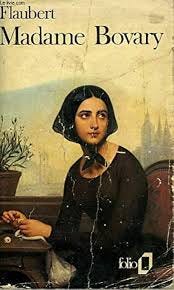
One of the most striking things about MB as a novel (other than how utterly readable and trip-a-long to flick the next page without having to re-read verbose sentences it is - compared to other texts of the time) is how much judgement Flaubert had for his own people, by which I mean the middle classes and their bourgeois drive for possessions and cultural improvements within a framework of conventional morals. As a doctor’s son himself, Flaubert mocks his father’s profession by making the cuckolded Charles Bovary an average doctor at best – a man who naively botches procedures and seems to be unable to think for himself (I’m squeamish and skim-read the pages held at arm’s length that describe a gangrened leg being amputated as a result of one of these mishaps). I liked Charles though, positively felt sorry for him and understood his conscious need to only see what was suggested to him, rather than the palpable truth which was only slightly hidden from view. Was I as a reader supposed to feel this though, or does it even matter? As is often the case in and out of fiction, the most interesting characters (in this case Madame Bovary) are the ones you like the least and might not feel pity for.
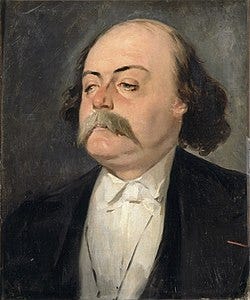
Flaubert kept a book as a young man that he labelled The Dictionary of Received Ideas where he kept a record of all the bourgeois snippets of conversation he’d overheard from medical men, parents, lawyers – sneering at their comments on daily life as well as larger subjects such as religion. He never seemed to fully be able to leave this comfortable cage that he so readily mocked, spending most of his life living in the home he grew up in. But his connections and influence span widely from this base – the famous people of his day that he fraternised with are impressive (six degrees of Flaubert would be a good game, but to be fair it would be difficult to link him to Kevin Bacon).
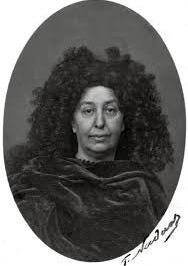
He exchanged letters with the French romantic era novelist George Sand – she of the masculine clothing and devil-may-care smoking in public who was Chopin’s lover. Their letters reflect a deep respect for one another’s writing. They even spent a Christmas together and the thought of them sharing a sherry surrounded by baubles seems fanciful. Flaubert also exchanged letters with Russian titan novelist Ivan Turgenev (Fathers and Sons) and they met several times mixing in soiree circles with Emile Zola and author Guy de Maupassant, who like Flaubert told stories of human destinies marred by social restraints. Incidentally, if you haven’t read Julian Barnes’ The Man in the Red Coat and are interested in the personalities of this period and social milieu, it is an absolute treat – but you will have to allow several additional hours of reading time for the dozens of Wikipedia vortexes it will send you down.
Flaubert’s writing influenced contemporaries and those who followed. Never had a novel with so little dialogue been so widely read. Emma Bovary herself as the eponymous (heroine is perhaps not the right word) only speaks for the first time several scenes after she first appears – attention is instead drawn to her hair, clothing, dainty feet and ankles. The reckless behaviour of a character who is driven to adultery by her own dreams, disappointments, and physical lust surely couldn’t have been far from D.H. Lawrence’s mind when writing Lady Chatterley’s Lover seventy years later; Flaubert’s creation also saw its writer prosecuted for publishing an immoral book, of which he was acquitted.
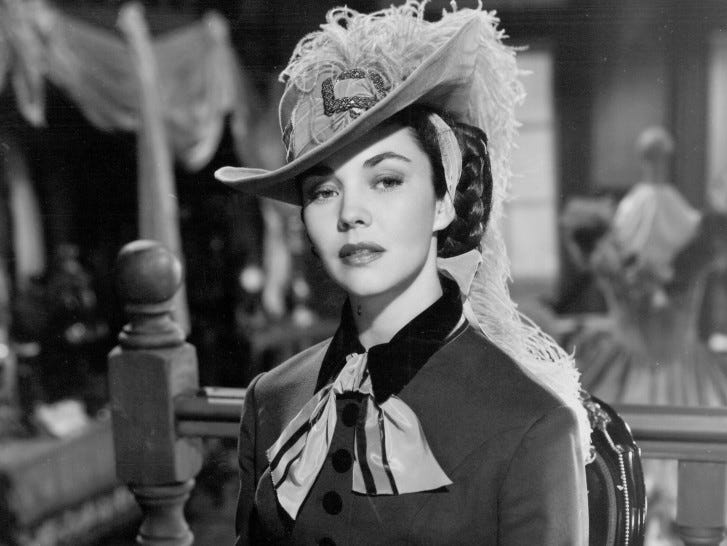
It seems that above all Flaubert was writing about the foolishness of us, mere humans. The prosecuting naysayers roaring about its seductions and adultery missed the point – it is a philosophical text about the mores of the human soul, how we will always be dissatisfied because life with its poor timings, trapped wind, bores at the party, and unforeseen mismatched reactions of oneself and others will never live up to the odourless and plotted timelines of the stage or dramatic novel. Madame Bovary imagines her life in a kaleidoscope of perfected forms that is unattainable – in one telling scene she thinks how it would be better to give up the piano if she cannot play it amongst candlelight in a silk gown surrounded by applauding gentlemen and women. Flaubert does not judge her for this though – the ending is brutal but does not read as a punishment, rather as an inevitable conclusion to a life that is curtailed by social restrictions and narrow ideals.
So I’m going to read more Flaubert – where to go next? The Temptation of Saint Anthony (title sounds a bit heavy), or Salammbo? There are many short stories too. Any advice, please let me know and thanks for reading.
Not ever read any Flaubert I dont think. Must do so although I think I maybe started Madame Bovary. Just can't get into reading at all at the moment! All I can think of is how his name reminders me of old fashioned pudding words like blancmange and posset and syllabub. Lovely lemon Flaubert will round off the meal nicely!
I'm sorry I'll take my irrelevant comments away! Always love your writing Lady Metroland xx
That photo of George Sand is indeed fabulous!
I can't held with a recommendation, sadly, as I think I've only ever read "Madame Bovary". It is an extremely moving book, though - Madame Bovary's dreamlife butting up against the practical realities of life. And I did feel so sorry for her husband!